Four Ways We Reduce Material Size
Every machine we build relies on one or more of four mechanical principles to break material down, and knowing which principle applies to your material is the first step in picking the right equipment. Impact works by striking friable material hard enough to cause fractures, which is how our cage mills, hammer mills, and horizontal and vertical shaft impactors operate. Shear tears or rips material apart, which matters for fibrous or stringy waste that doesn't fracture cleanly under a straight impact blow. Compression breaks material by squeezing it between two surfaces, the method behind roll and jaw crushers. Attrition reduces material through pieces colliding with each other rather than against a fixed surface, which we rely on for some of our finer grinding applications. Most materials respond best to one of these methods over the others, and testing your actual material tells us which one that is rather than guessing from a material name alone.


What is Size Reduction?
Size Reduction = Material + Energy
Stedman Machine Company uses the size reduction expertise to help evaluate, test, and specify the best size reduction equipment for your application driven project. Stedman Machine uses different styles of crushers, grinders, cage & chain mills based on the raw material being processed.
What are the types of Size Reduction Equipment?
- Impact – hitting friable material causing fractures
- Shear – tearing or ripping
- Compression – breaking material by squeezing
- Attrition – material pieces colliding with each other causing reduction
Size Reduction Equipment Resources

How do I know what Type of Size reduction Machine I Need?
Crushers are often described as Primary, Secondary, Tertiary, etc. depending on how many size reduction steps are needed and where within the process each reside. There are many types of equipment choices but selecting one depends on the answers to the following questions:
- What is the material?
- What is the moisture content?
- What is the maximum size going into the machine?
- What is the size ranged desired after crushing?
- What is the desired production rate of finished product?
Crushing & Size Reduction Equipment Available:
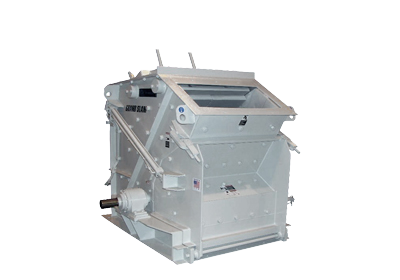
- Primary & Secondary Horizontal Shaft Impactors
- VSlam™ brand Vertical Shaft Impactors
- Stedman™ brand Cage Mill Disintegrators
- Single Cage King Series
- Two-row – coarser grinds
- Four-row – intermediate finer grinds
- Six-row – fine grinds for less abrasive materials
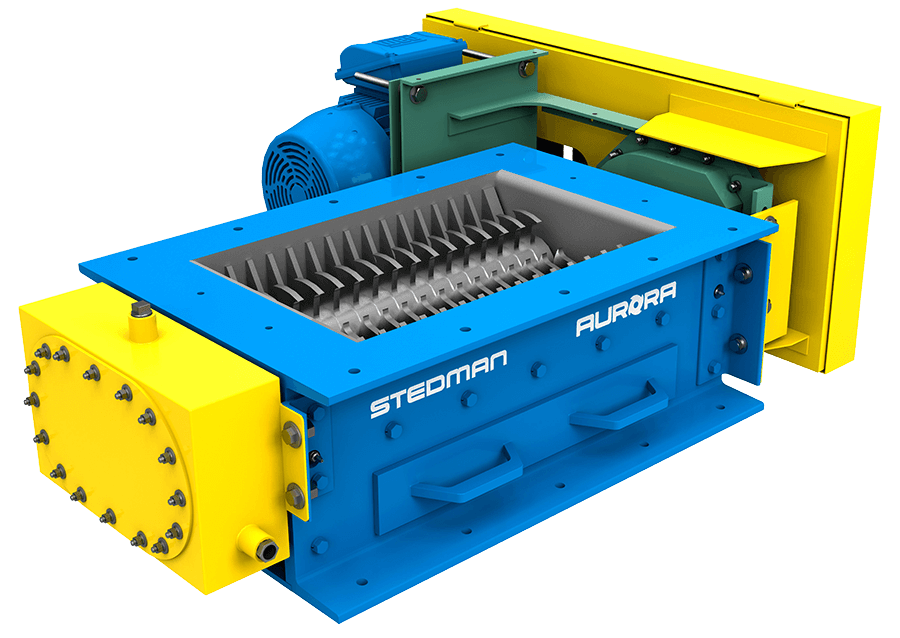
- Aurora™ brand Lump breakers
- Single rotor
- Dual rotor
- Single and Dual Rotor Chain Mills
- Hammermills
- Up running
- Down running
- Full circle air-swept
- Fine Grinders
- VRollermax™ brand Vertical Roller Mills
- MicroMax™ brand Fine Grind Air Swept Mills
- Custom crusher designs for special application needs
- High Temperature
- Stainless Steel; 304L, 316L
- Highly cleanable; semi-sanitary
Particle Size Reduction Equipment:


More About Particle Size Reduction Equipment
Today, there are many different size reduction machines available to make little pieces out of big ones. Particle size reduction equipment includes primary impact crushers and secondary crushers as well as milling machines - cage mills, hammer mills, pulverizers, and grinders.
Stedman manufactures a full line of particle size reduction equipment — primary impactors, secondary crushers, tertiary impactors, plus cage mill pulverizers, hammer mill crushers and lump breakers for the aggregate, mining, and industrial markets. Materials processed fall into broad categories including abrasive, non-abrasive, wet or dry, sticky, and friable. Stedman's experience evaluating these factors helps target the correct size reduction equipment for each unique project.
Custom and Specialty Equipment Beyond Our Standard Lines
Beyond our standard crushers, cage mills, and hammer mills, we build custom configurations for material and environments that standard equipment isn't designed for. This includes high temperature configurations for processes running hot material, stainless steel construction in 304L and 316L for corrosion resistance, and highly cleanable, semi-sanitary designs for operations where washdown and contamination control matter. If your material or environment doesn't fit a standard product line, from food and rendering byproduct to corrosive or high-temperature process streams, tell us the specifics and we'll tell you whether a custom configuration is the right approach.
Test Before You Buy™
The Stedman Testing and Toll Processing Facility is the place to test your material in our full size equipment. If it can be crushed, ground, pulverized or mixed, chances are we’ve done it. We have more than 10,000 test reports to help get you to the best solution quickly. To learn more about what to expect from testing, read our article that ran in POWDER BULK ENGINEERING magazine.
Why Stedman?
For nearly two centuries, Stedman Machine Company has produced quality, reliable, and durable size reduction and industrial crushing equipment. Stedman has expert field service and installation technicians ready to assist with all maintenance and equipment commissioning needs.
- Unsurpassed industry experience – operating since 1834
- State-of-the-art equipment testing facilities
- Dedicated, professional staff
- Parts and service are available 24 hours a day
- Installation & maintenance services
Size Reduction Machine FAQs
Cost depends on the equipment type, capacity, wear part specification, and whether you need a custom configuration like stainless steel or high-temperature construction. Rather than quote a general price range that wouldn't reflect your actual project, we recommend sending us your material and production requirements so we can put together an accurate quote.
It depends on the equipment and what's driving the need for a change, whether that's a capacity increase, a material change, or wear part failure. Our 24-hour parts and service department can evaluate your current setup and tell you whether a retrofit, rebuild, or new equipment makes more sense for what you're trying to solve.
Primary crushers handle the first reduction step on the largest incoming feed size, typically coarse material straight from a mine or quarry. Secondary crushers take that output down further, and tertiary equipment, like our cage mills, handles the final fine-grinding step. Not every process needs all three stages. Some materials only need one or two steps to reach the target particle size.
Yes. We bring used and refurbished crushing equipment back to full working condition rather than only selling new machines. If budget or lead time is a factor in your project, ask us whether a refurbished unit fits your material and production requirements before committing to new equipment.
Lead time varies by equipment type, configuration, and whether it's a standard or custom build. We also offer field service and installation technicians to assist with commissioning once equipment arrives, which shortens the gap between delivery and full production. Ask us for a specific lead time estimate once we know your equipment configuration.
Some equipment handles a range of materials well, while others are configured tightly around one material's hardness, moisture, and abrasiveness profile. If you expect your material mix to change, tell us that upfront during testing so we can recommend equipment with enough flexibility to handle the range, rather than a machine optimized for only one material.
Contact Us
Our 24 hour parts and service department along with our inventory of wear parts allow us to provide the fastest response time for parts and service.