
Get the Super-Fine Grind You Need Without the High System Cost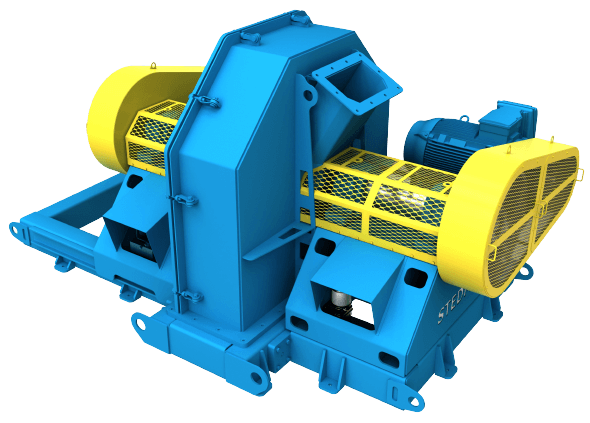
The grinding system you choose greatly impacts your capital investment, operating costs, and day-to-day production if your limestone operation produces agricultural lime, hydrated lime, quicklime, or cement feedstock.
For many quarry applications, a cage mill, like Stedman’s X-Series super-fine grind cage mill, provides a simpler, more economical alternative to traditional fine-grinding systems such as vertical roller mills, ball mills, and rod mills.
Cage mills use high-speed impact to reduce limestone and other friable materials to the desired particle size. Their straightforward design helps reduce the amount of equipment required around the mill.
Compared with larger grinding systems, cage mills offer opportunities for lower installed system costs, which include:
- Simpler mill construction and foundations
- Less auxiliary equipment
- Reduced mechanical complexity
- Smaller footprint
- Simplified material handling
- Lower installation and commissioning requirements
- Straightforward integration into existing crushing circuits
While every application requires an engineering evaluation, the combination of equipment simplicity and efficient impact grinding can make a fine grind cage mill an attractive choice when a quarry needs to add fine-grinding capability without investing in a large, complex grinding circuit.
Simpler Operation for Quarry Personnel
Capital cost isn’t the only consideration. A grinding system also needs to be practical for the people who operate and maintain it. Cage mills offer a relatively simple operating concept. Quarry personnel can focus on the key variables affecting production, like feed rate, mill operation, material flow, and product sizing, rather than managing a highly complex grinding circuit.
Compared with systems that may require more extensive control strategies and multiple pieces of auxiliary equipment, a properly designed cage mill installation can provide:
- Fewer components to monitor.
- Simpler controls.
- Straightforward startup and shutdown.
- Easier routine maintenance.
- Less operator complexity.
That simplicity is particularly valuable for aggregate producers who are adding a new fine-grinding process to an existing quarry operation.
One Grinding Solution. Multiple Limestone Applications.
A cage mill can provide the size reduction needed for a variety of limestone processing applications, including:
- Agricultural Lime
Produce finely ground limestone for agricultural applications where controlled particle size is important for soil conditioning. - Lime Production
Prepare properly sized limestone feed for downstream processing into quicklime or hydrated lime. - Cement Production
Provide fine grinding and size reduction as part of limestone preparation and cement-related processing systems.
The Bottom Line
If your quarry is considering a new fine-grinding installation, don’t automatically assume a vertical roller mill, ball mill, or rod mill are the only solutions. A cage mill may deliver the required particle size with a simpler system, lower installed costs, and easier operation for your quarry team.
Our team can evaluate & test your material, target product size, required capacity, and existing plant configuration to determine whether a cage mill is the right fit for your operation.
Ready to see what a cage mill could do for your limestone operation?
Contact us to discuss your application and evaluate a grinding system designed around your production goals.